
Product-market fit can be a big challenge for companies with new innovations. Many struggle to align their technologies with the interests of the market.
Luckily for generations of kids, the company behind Play-Doh kept its eyes open when its original product began to falter. It’s a fascinating case study that provides four great lessons in product-market fit.
The Story of Play-Doh
Play-Doh began as wallpaper cleaner in 1933. Yes, wallpaper cleaner! It was produced by a company called Kutol, which was owned by brothers Cleo and Noah McVicker.
Back then most homes were heated by coal, which left a layer of soot everywhere. Because walls were commonly covered in wallpaper, a special cleaner was required.
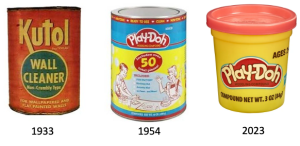
Fast-forward to the years following WWII. Coal heat was being replaced by gas and oil, and wallpaper cleaner was becoming obsolete. Kutol was in trouble.
Everything changed in 1954.
Just down the road from the Kutol factory, a relative of the McVicker brothers, Kay Zufall, was operating a nursery school. She needed an inexpensive material for her students to make Christmas decorations, and she read about using non-toxic wallpaper cleaner. Kay ran to the store for a few cans.
Kutol turned out to be perfect for the craft project – and the kids absolutely loved playing with it. Kay excitedly called Joe McVicker. “You need turn that wallpaper cleaner into a toy!”
To his credit, Joe listened. Kutol removed the detergent from the dough, and he added a faint almond scent and coloring.
Joe wanted to call this new toy “Kutol’s Rainbow Modeling Compound,” but Kay convinced him it was a terrible name. Instead, she came up with “Play-Doh.”
Now Joe needed to get Play-Doh into the hands of kids. They had no money to advertise due to the company’s financial struggles. So Joe talked his way into a meeting with Bob Keeshan, also known as Captain Kangaroo. Keeshan agreed to use the product once a week on Captain Kangaroo in exchange for a 2% royalty.
The creative approach to advertising worked. Play-Doh became a roaring success – and it remains so today. More than 3 billion cans of Play-Doh have been sold!
Product-Market Fit Lessons from Play-Doh
Don’t be afraid to reposition as the market changes
Too many companies fall in love with their product and what it was created for. They don’t – or can’t – see the other possibilities.
Fortunately, Kutol didn’t fall into this common trap. Thanks to an outside point of view, they pivoted from wallpaper cleaner to invent an entirely new toy category.
You always need to be flexible and open. Talk to people outside your company and in different industries. Ask them how they use your product or service. When I talk to my clients’ customers, I often learn about novel product use cases.
Realign branding to your target customer
To reach the market of teachers, parents, and kids, Kutol used a playful name – Play-Doh (and demoted the technically descriptive yet boring “modeling compound” name to a sub-head, which remains on the label today). They also added red, blue, and yellow coloring for visual appeal, and clearly positioned it against the competition: dirty and messy clay.
Every aspect of your marketing needs to align with your target market – product features, packaging, messaging, testimonials, collateral, etc.
Go guerrilla when bringing your product to market
Channel-to-market is key to gaining customers and market traction. Be creative and open to niche channels that can put you in front of your ideal target buyer. Consider targeting industry associations, trade publications, solution integrators, social influencers, universities, and analysts.
Product placement on Captain Kangaroo was a brilliant channel for Play-Doh, which quickly propelled the product from a local to a national brand.
Spark the imagination of buyers
Your potential buyers may be set in their ways. So they may not immediately understand how your innovative product will fit into their world. That’s why great positioning, messaging, demos and use cases are so important.
An early TV commercial for Play-Doh brought their “use cases” to life. Viewers saw teachers using it in the classroom, and kids playing with it at home. As the company added accessories, commercials showed kids eagerly squishing Play-Doh into molds and through spaghetti presses.
6 Questions to Help you Find Product-Market Fit
When aligning your product with the market, ask yourself:
- Is our product a “nice-to-have” or a “must-have”? (Be honest with yourself)
- How are customers actually using the product today (versus how we think are)?
- Does our value proposition 100% connect with the buyer’s pain points?
- Are there other high-value uses for our product that we haven’t considered?
- Does our marketing brand make sense for our target buyer?
- Is the product being promoted where our target buyer is looking?
If you are stuck and need help with product-market fit, contact me today.